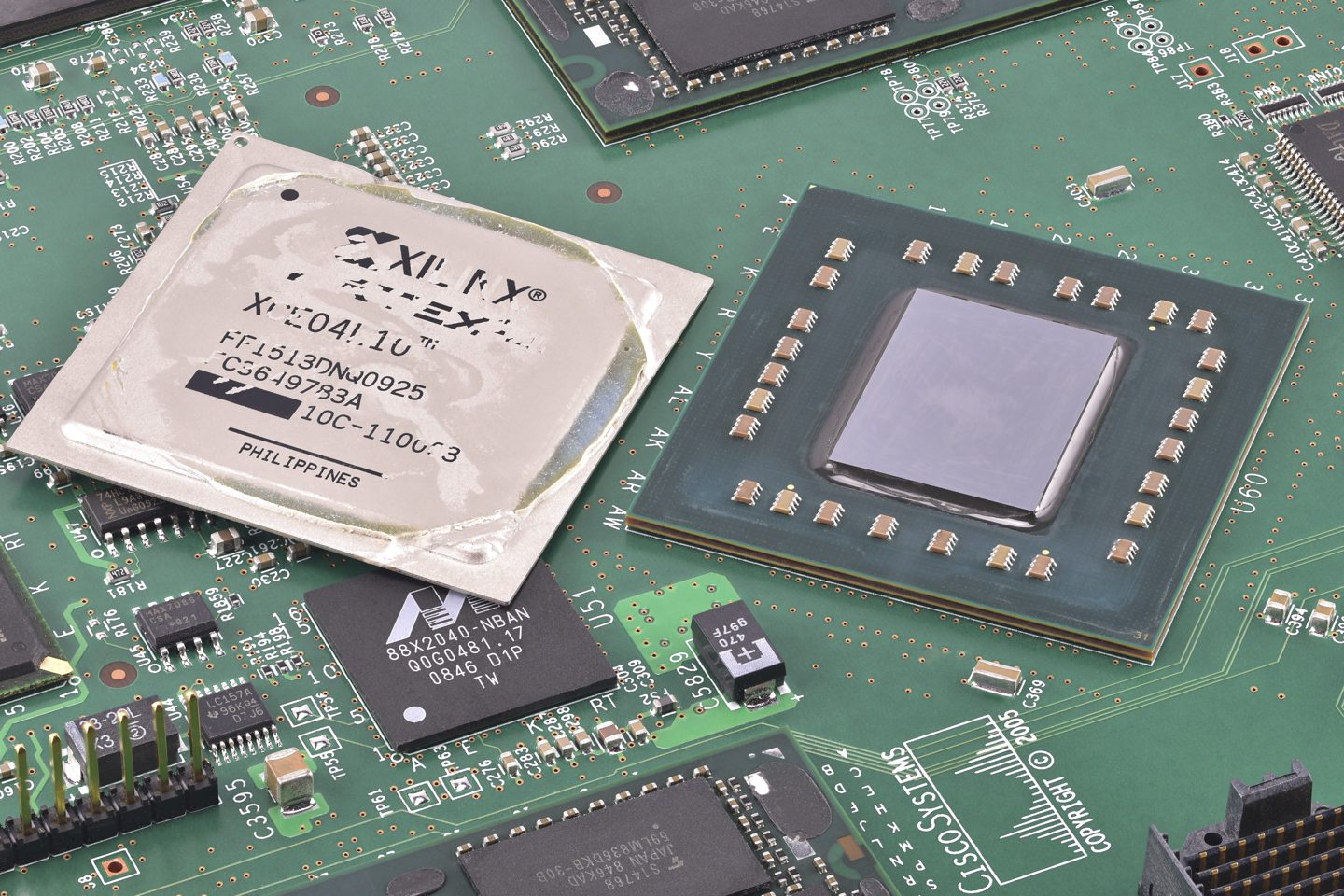
A field-programmable gate array, or FPGA, is a computer chip whose internal circuitry can be rewired after it leaves the factory. Instead of running fixed logic that was etched in during manufacturing, an FPGA loads a configuration file that turns its grid of programmable blocks into whatever digital circuit a job requires. That flexibility, plus split-second, predictable timing that general-purpose processors struggle to guarantee, is why FPGAs have become a fixture inside modern AI hardware — from data-center accelerators to the real-time controllers now shipping inside robots.
What an FPGA Actually Is
Most chips are fixed at the factory: a CPU or GPU is manufactured with a specific set of circuits and can only ever run software on top of that fixed hardware. An FPGA is different. It’s built from thousands of small, identical logic blocks connected by a programmable wiring grid. Engineers describe the circuit they want — using hardware description languages like VHDL or Verilog — and that design compiles into a “bitstream” that configures the chip’s blocks and interconnects into an actual custom circuit. Reprogram the bitstream, and the same physical chip becomes a different circuit entirely.
Xilinx, founded in 1984 by three former Zilog engineers, shipped the first commercially viable FPGA, the XC2064, in 1985. The category grew steadily in networking, aerospace, and industrial gear for decades before AI workloads gave it a second life. AMD acquired Xilinx in 2022, folding FPGA technology directly into its chip lineup alongside its GPUs and CPUs.
FPGA vs. GPU vs. ASIC
It helps to think of AI hardware as a spectrum. A GPU is general-purpose and programmable in software, but every unit runs the same fixed hardware — great for the parallel math behind training and running AI models. An ASIC sits at the other extreme: a chip custom-designed and manufactured for one job, which makes it the fastest and most power-efficient option but takes months or years to design and can’t be changed once it’s built. An FPGA sits in between. It isn’t as raw-efficient as a purpose-built ASIC — older industry benchmarks put a typical FPGA implementation at roughly an order of magnitude less area- and power-efficient than an equivalent ASIC — but it can be reprogrammed in the field, and it can guarantee the kind of deterministic, microsecond-scale timing that software running on a CPU or GPU generally cannot.
Why AI and Robotics Hardware Uses Them
That determinism is the key. An AI model doing perception or reasoning on a GPU or a dedicated neural engine works in probabilistic, variable-length steps — great for interpreting a camera feed, less suited to guaranteeing a robot’s control loop fires at a fixed interval. FPGAs are built to close that gap: they handle real-time I/O, sensor fusion, and safety interlocks with predictable, hardware-level timing, while a separate processor handles the AI reasoning.
AMD’s newly launched Kria AI Robotics Developer Platform is a working example of this split. It pairs a Ryzen AI Embedded system-on-module — combining a CPU, GPU, and NPU on shared memory — with a carrier board built around an integrated FPGA that handles real-time control, sensor fusion, and safety functions, while the AI accelerators run vision and language-based reasoning models. The design reflects a broader pattern across robotics and physical AI hardware: let a flexible AI processor handle perception and planning, and let an FPGA guarantee the timing-critical parts can’t be skipped or delayed.
Why It Matters
FPGAs let hardware makers ship a working product before an interface or protocol has fully settled — useful in a field like robotics and AI where standards and sensor formats are still evolving. A company can deploy custom logic on an FPGA now, then migrate that same logic to a cheaper, faster ASIC later once the design is proven at scale and the extra engineering cost is worth it. That’s also why FPGAs turn up in AI data centers: Microsoft, for instance, has used FPGAs across Azure to accelerate specific AI and networking workloads without waiting for custom silicon. For a fast-moving field like AI hardware, that reprogrammability is often as valuable as raw speed.
In the News
AMD’s Kria AI Robotics Developer Platform, announced as an open, integrated hardware and software stack for building autonomous robots, is one of the clearest recent examples of FPGAs being paired directly with AI accelerators in a single product aimed at physical AI.