Quantum computing is a way of processing information that uses the rules of quantum mechanics instead of the on/off logic every regular computer runs on. It isn’t a faster version of the laptop you’re reading this on — it’s a fundamentally different kind of machine, good at a narrow set of problems ordinary computers struggle with, and it does not run today’s AI chatbots. What it does share with AI, increasingly, is a two-way relationship: machine learning is already helping quantum computers work better, and quantum computers may eventually help AI in return.
A qubit isn’t just a faster bit
A classical computer stores information as bits — each one strictly a 0 or a 1. Quantum computing stores it in qubits, which can hold a combination of both states at once, a property called superposition. Two qubits together can represent four combinations simultaneously; three qubits, eight; and the count doubles with every additional qubit. That exponential growth in the space a quantum computer can represent — not raw speed — is where its theoretical advantage comes from.
Qubits can also be linked through entanglement, so that measuring one instantly tells you something about another, however far apart they are. Superposition and entanglement together let a quantum computer explore many possible answers to certain problems at once, rather than checking them one by one the way a classical processor does.
Why one is so hard to build
The catch is that superposition is fragile. Stray heat, vibration, or electromagnetic noise makes a qubit “decohere” — collapse out of its quantum state — often within microseconds. Today’s machines run at temperatures colder than deep space and still make errors constantly, so a handful of raw physical qubits doesn’t equal a handful of usable ones; many noisy physical qubits have to be combined into one reliable “logical” qubit through error correction, and that overhead is the main reason large, general-purpose quantum computers don’t exist yet.
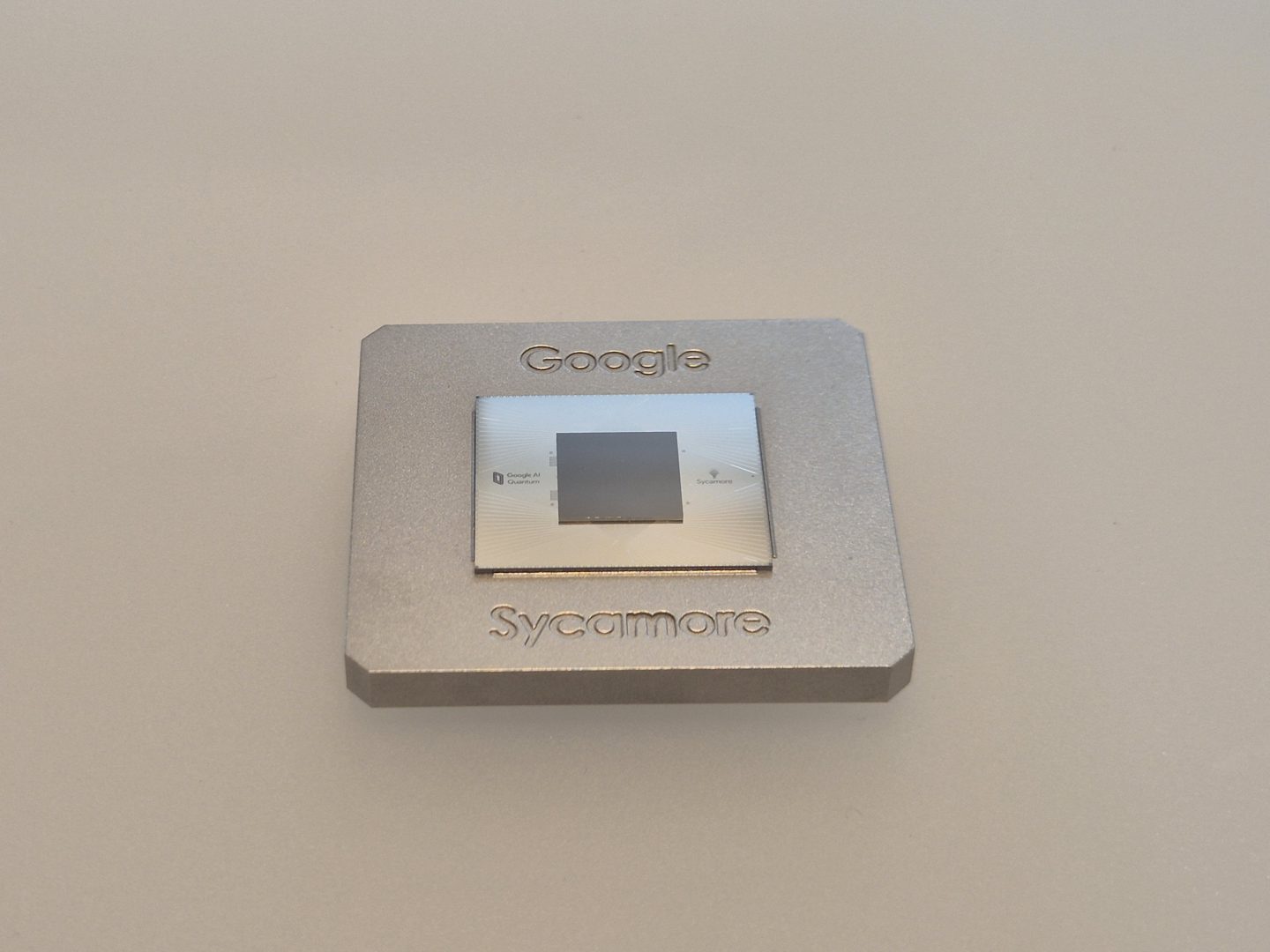
Companies including IBM, Google, and Microsoft have run experiments — such as Google’s 2019 Sycamore chip — showing a quantum processor can finish a contrived, purpose-built calculation faster than a classical supercomputer. None of that has yet translated into a quantum computer outperforming classical machines on a genuinely useful, real-world task; most researchers describe that milestone as still ahead, not behind us.
AI is already helping quantum computers work
The clearest link between the two fields today runs from AI into quantum hardware, not the other way around. In 2024, Google DeepMind and Google Quantum AI published AlphaQubit in the journal Nature: a neural-network decoder built on Transformers — the same architecture behind most modern chatbots — trained to read the noisy signals coming off a quantum chip and figure out whether an error actually happened. Tested on Google’s Sycamore processor, it cut errors by 6% compared with the previous best mathematical method and by 30% compared with a faster, widely used alternative. Decoding errors correctly, fast enough, is one of the central obstacles to building a quantum computer that can run longer, more useful programs — and it’s now something an AI model helps do.
The reverse direction — quantum computers speeding up AI — is far more speculative. A research field called quantum machine learning explores whether quantum algorithms could accelerate parts of machine learning, such as optimization or sampling. So far, most proposed advantages rely on theoretical assumptions that haven’t held up on real hardware, and quantum computers are not expected to train or run large language models in the foreseeable future — they’re solving a different class of problem than the specialized chips that train and run today’s models.
Why it matters beyond the lab
Quantum computing’s clearest near-term stakes for AI are less about speed and more about security. Much of the encryption protecting today’s internet — including the data pipelines and APIs behind AI systems — relies on math problems that are hard for classical computers but could, in theory, be broken by a large enough fault-tolerant quantum computer. That risk is why post-quantum cryptography already exists as a field, well before such a machine has been built.
Meanwhile, AI’s most pressing hardware problem remains one that quantum computing doesn’t solve: the shortage of ordinary compute needed to train and run today’s models. Quantum processors target a narrow set of optimization, simulation, and cryptography problems — not a replacement for the GPUs and AI chips training and serving current AI.
Curious readers don’t have to take any of this on faith: IBM offers free monthly access to run real circuits on its quantum processors through the IBM Quantum Platform, no physics degree required.