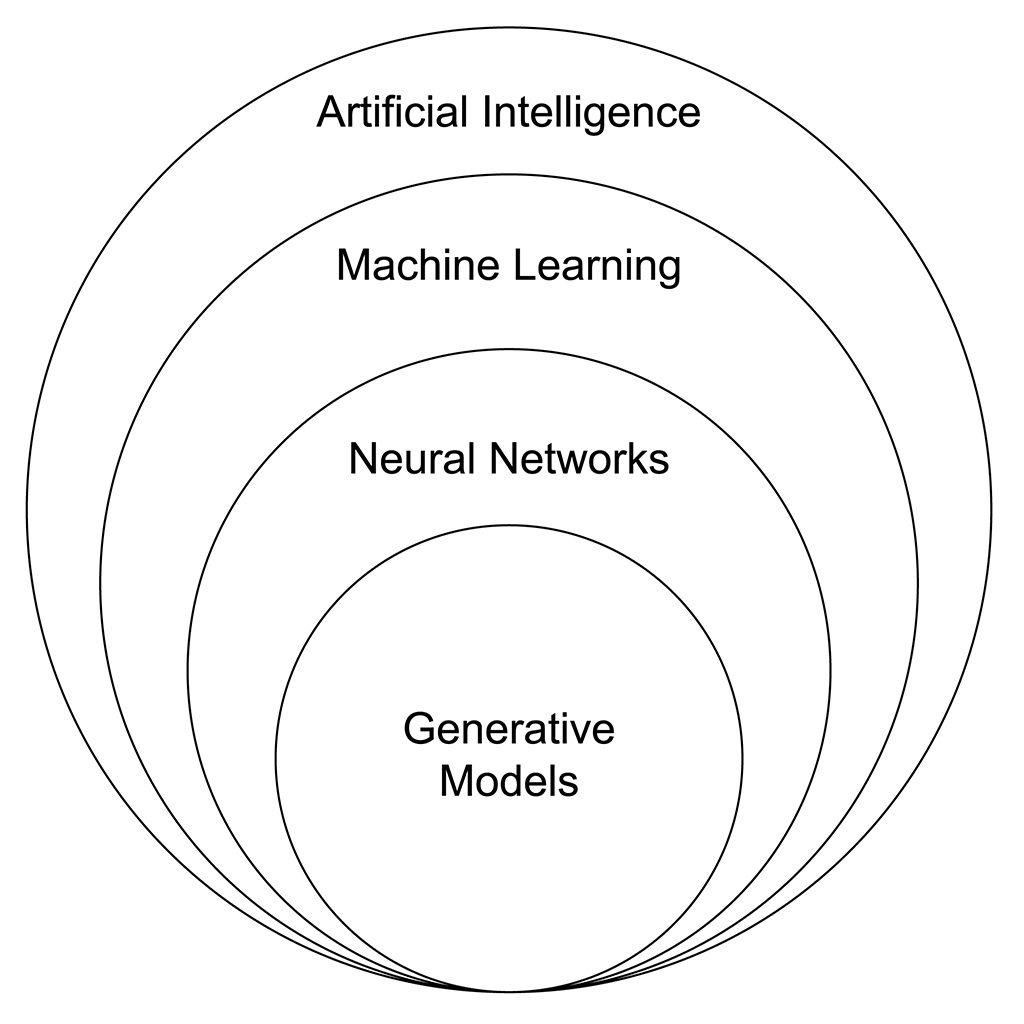
Generative AI is a category of artificial intelligence that produces new content — text, images, audio, video, or software code — rather than simply sorting, scoring, or predicting from existing data. When someone types a prompt into ChatGPT or Midjourney and gets back an original paragraph or picture, that’s generative AI at work.
What makes it “generative”
Most AI systems built before the 2020s were what researchers call discriminative: a spam filter decides whether an email is junk, a fraud model scores a transaction as risky or not, a recommendation engine ranks products you might buy. These systems classify or predict based on patterns they’ve seen — they don’t create anything new.
Generative AI is different. It’s built on machine learning models trained to learn the underlying statistical structure of a dataset well enough to generate brand-new examples that fit that structure. A model trained on millions of photographs of cats doesn’t just learn to recognize a cat — a generative model learns what makes a cat look like a cat, closely enough to produce a convincing new image of one that never existed. The same idea applies to text, code, and sound. Systems built this way are sometimes described more broadly as large language models when the content is text.
How it actually works
Most text-generating systems today, including ChatGPT and Claude, are built on a neural network design called the transformer, introduced by Google researchers in 2017. A transformer processes a whole passage of text at once and weighs how strongly each word relates to every other word, which lets it predict a plausible next word — then the next, then the next — one token at a time. Trained on enormous volumes of text, it becomes very good at continuing a prompt in ways that read as coherent, relevant answers.
Image generators typically work differently, using what’s called a diffusion model. Training teaches the system to reverse a process of adding random noise to an image step by step, until it can start from pure static and “denoise” its way to a coherent picture that matches a text description. An older technique, the generative adversarial network (GAN), pits two neural networks against each other — one generating fakes, one trying to catch them — until the fakes become convincing; it’s now less common than diffusion for image generation but was influential in the 2010s.
In every case, the model isn’t retrieving a stored answer or copying a specific example from its training data. It’s producing a new sequence of words, pixels, or sound that statistically resembles what it learned. That’s also why these systems can state confident-sounding things that are simply wrong — a well-documented limitation known as hallucination — because the model is optimizing for plausible output, not verified truth.
Why it matters
Generative AI reframed what people expect a computer to do. Instead of only calculating, sorting, or matching, software can now draft a memo, debug code, translate a document, or produce a rough illustration on request. Since ChatGPT’s public launch in November 2022, generative tools have moved from research demos into everyday products: word processors, design software, coding editors, and customer-support systems now embed generation features by default.
That shift also carries real costs. Running these models — especially at the scale of a service used by hundreds of millions of people — takes far more computing power than older AI systems, which is a direct reason data-center construction has accelerated worldwide; Meta’s expanding Louisiana AI data center is one recent example of that buildout. Generative AI also raises unresolved legal questions — who owns content a model creates when it was trained on copyrighted material — and practical ones, like verifying outputs before relying on them.
Sources: IBM — What is Generative AI?, Wikipedia — Generative artificial intelligence, Coursera — What Is Generative AI?