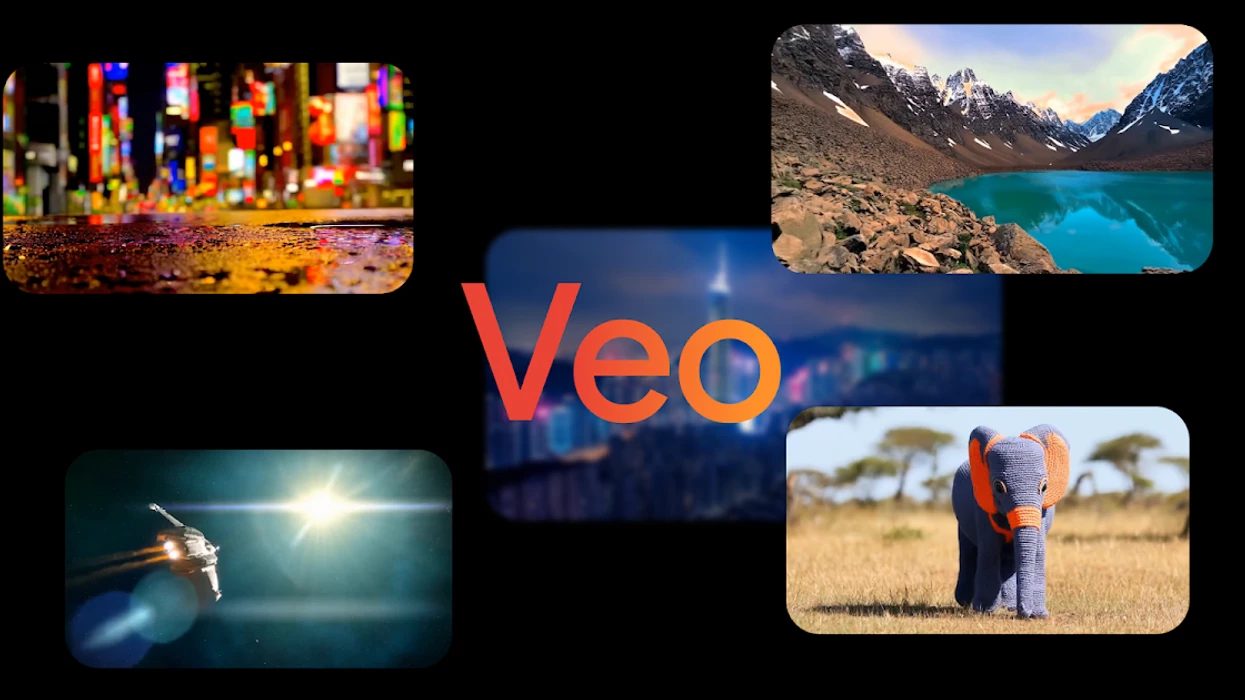
AI video generation is the use of generative AI models to create moving video — usually a clip of a few seconds to a couple of minutes — from a written prompt, a still image, or existing footage, without a camera, actors, or a film crew. The best current systems also generate synchronized dialogue, ambient sound, and sound effects, not just silent footage, and the same generative AI systems can edit or extend a clip you already have rather than only creating one from scratch.
How It Works
Most of today’s tools are built on an architecture called a diffusion transformer, applied to what’s technically known as a text-to-video model. Training video is encoded into a compressed grid of “spacetime patches” — small chunks of pixels sampled across both the frame and the timeline, rather than whole frames one at a time. The model then learns to reverse a noise-adding process: starting from random static, it gradually removes noise, step by step, until a coherent sequence of frames emerges. This is the same core idea behind the diffusion models used for still images, extended across a time dimension so a character’s face or a moving object stays consistent from one frame to the next instead of flickering or warping.
Because training clips are diced into patches instead of fixed-size frames, one model can learn from video of many different lengths, resolutions, and aspect ratios at once — a big part of why quality improved quickly once major labs adopted this approach.
From Blurry Clips to Coherent Scenes
Early AI video systems, built on generative adversarial networks, could only produce a few seconds of low-resolution, jittery footage. Around 2022–2023, diffusion-based tools such as Runway’s Gen-1 and Gen-2 and Stability AI’s Stable Video Diffusion learned to animate a still image into a short clip. The clearer turning point came in February 2024, when OpenAI demonstrated Sora, showing minute-long clips with unusually consistent characters and physics, built on the spacetime-patch approach described above. Google, Runway, Kuaishou’s Kling, Luma AI, and others followed with their own models; by 2026, clips of roughly 8 to 20 seconds with native, synchronized audio are standard among the leading tools.
Sora itself is no longer where to try this: OpenAI discontinued the Sora consumer app in April 2026 and is winding its API down later the same year, redirecting the underlying research toward general-purpose “world models” instead of a public video product. The approach it helped popularize lives on in its competitors.
What It’s Good At — and Where It Still Struggles
These models are strong at short, stylized or atmospheric clips: product shots, animated storyboards, b-roll, social content, and previsualization for film and advertising. They still struggle with precise physics (liquids, collisions, fast motion), keeping a character’s appearance identical across a long cut, rendering legible on-screen text, and following highly specific, multi-step instructions — the video equivalent of a chatbot hallucinating a plausible-looking but wrong detail.
How to Try It
Google Flow, built on Google’s Veo models, is a straightforward way to see the technology yourself: enter a text prompt or upload a photo, and a free daily credit allowance covers a handful of generations before paid plans kick in. As of July 2026, per Google’s own pricing page, the underlying Veo 3.1 API costs from roughly $0.05 per second at the cheapest tier and resolution up to $0.60 per second at the highest quality, while Flow’s consumer plans start around $4.99 a month for more daily credits. Runway, Kuaishou’s Kling, and Luma AI’s Dream Machine are other widely used options, each with its own free trial and paid tiers, and worth comparing if you’re exploring tools for a video workflow rather than a one-off clip.
Why It Matters
AI video generation is already cutting the cost of footage that once needed a camera crew, actors, or an animation studio — useful for advertising, education, and previsualization, but also disruptive to parts of the video production industry. It raises the same concerns as other synthetic media: a model that can generate a dancing product mockup can, in the wrong hands, generate a fake clip of a real person saying something they never said. That risk has pushed most major video tools to restrict generating recognizable real people without consent and to embed visible or invisible markers flagging content as AI-generated, part of a broader push against deepfakes.
In the News
Google’s Gemini Omni Flash, announced as a conversational video-editing model, shows where the technology is headed next: instead of generating a clip once, you describe the change you want to an existing video and the model edits it — blurring the line between video generation and video editing.