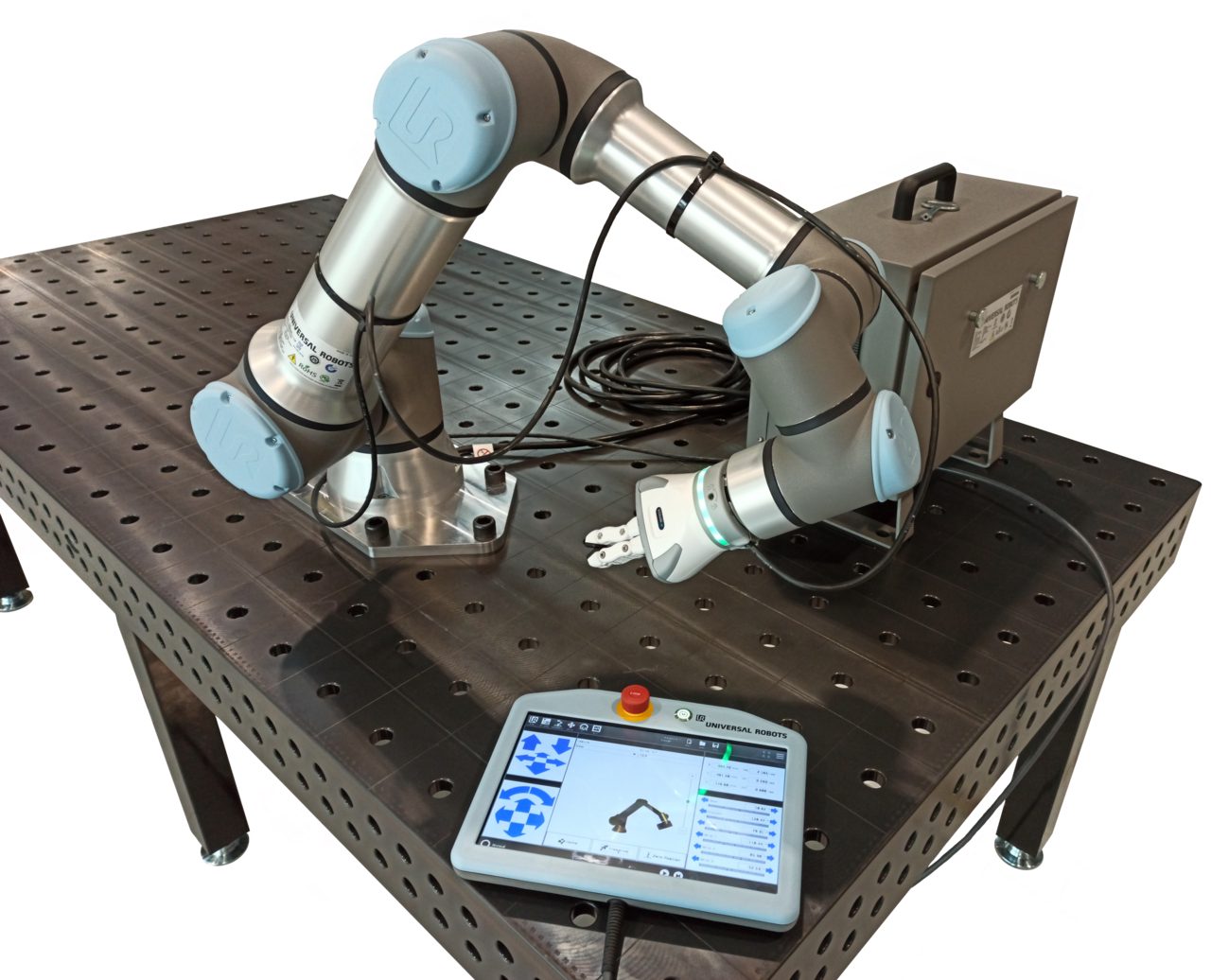
A vision-language-action (VLA) model is an AI system that takes a camera image and a plain-language instruction and outputs the physical motions a robot needs to carry it out — turning a request like “pick up the red cup” directly into arm and gripper movements, inside one model instead of a chain of hand-coded programs.
From separate pipelines to one model
Robots have traditionally been built from separate, hand-engineered stages: a vision system identifies objects, a planner decides what to do, and a controller turns that plan into motor commands. Each stage is tuned for a narrow set of objects and tasks, so a robot rarely handles anything its engineers didn’t specifically prepare it for.
A vision-language-action model collapses that pipeline into one. It borrows the same transformer-based architecture used in large language models, but instead of only producing text, it produces a stream of robot actions — joint angles, an end-effector position, a gripper command — directly from what it sees and what it’s told to do.
How it works
A VLA model runs in two connected stages. First, a vision-language backbone — often adapted from an existing multimodal model — encodes the camera feed and the text instruction into one shared representation of what’s happening and what to do about it. Second, an action decoder turns that representation into a robot command, and the whole loop repeats many times a second so the robot keeps adjusting as its surroundings change.
Different models decode that final step differently. Google DeepMind’s RT-2, unveiled in July 2023 as the first major VLA, discretized each dimension of a robot’s motion into 256 bins and predicted them as tokens, the same way a language model predicts words. Physical Intelligence’s π0, released in late 2024, instead uses flow matching — a technique related to the diffusion models behind AI image generators — to output smooth, continuous motion at up to 50 times a second, which matters for tasks like folding laundry or plugging in a cable.
A fast-moving field
Since RT-2, the field has moved quickly. OpenVLA, released in June 2024 by a Stanford-led team with Berkeley, Toyota Research Institute, Google DeepMind and Physical Intelligence, is a 7-billion-parameter model trained on more than a million demonstration episodes across 22 different robots — and it’s fully open-source, so anyone curious can download and fine-tune it themselves. Nvidia followed in March 2025 with Isaac GR00T N1, billed as the first open foundation model for humanoid robots, and Google DeepMind launched Gemini Robotics the same month, built on its Gemini 2.0 model with physical action added as a direct output alongside text.
Why it matters
Because a VLA model learns from web-scale image-and-text data alongside robot demonstrations, it can generalize to objects and phrasings it never specifically saw during training, rather than needing a new hand-coded routine for every task. That generalization is the core promise behind the current wave of physical AI and humanoid robots — machines meant to work in ordinary homes and warehouses rather than the fixed, pre-mapped floor of a factory.
It also creates a hardware problem. Running the see-decide-act loop fast enough for a robot to react in real time takes real computing power, and that computing has to happen on the robot itself, not in a distant data center. Chipmakers have taken notice: dedicated modules for exactly this workload are now a competitive battleground in embedded computing.
In the news
AMD’s push into that battleground, detailed in our brief on its new Kria AI Robotics Developer Platform, claims a full vision-language-action cycle can run in under 100 milliseconds on the new hardware — a direct challenge to Nvidia’s Jetson modules, which have powered most VLA-driven robots to date.