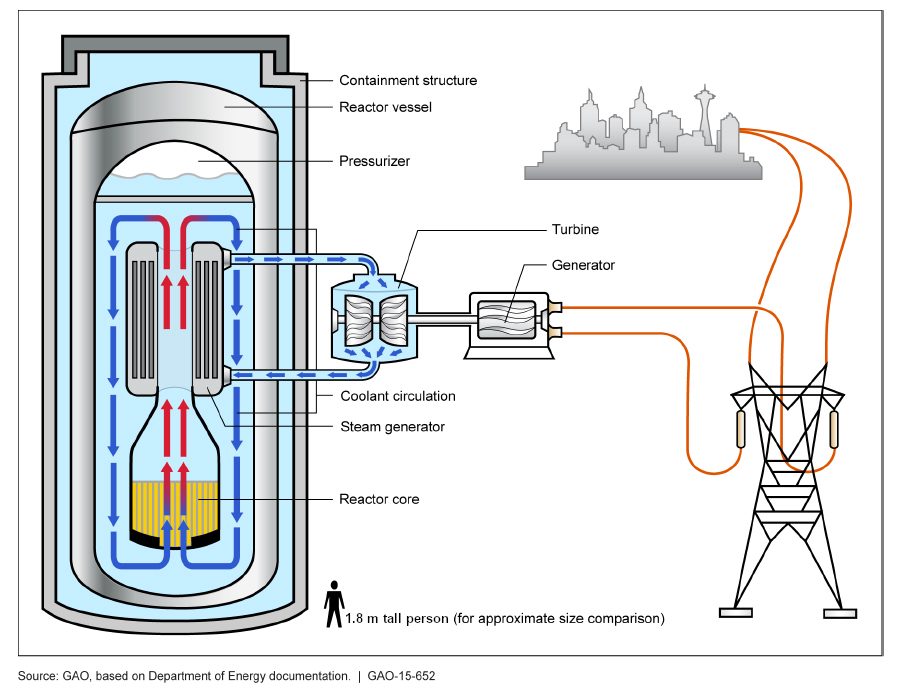
A small modular reactor (SMR) is a nuclear power plant designed to generate no more than 300 megawatts of electricity — roughly a fifth to a third of what a conventional reactor produces — with its core components built in a factory and shipped to the site as finished modules, rather than assembled brick by brick over a decade of on-site construction. Engineers have discussed the idea for decades, but it has become a live investment story only recently, as AI data centers started demanding more electricity, more reliably, than the existing grid can easily deliver.
What makes a reactor “small” and “modular”
The International Atomic Energy Agency defines an SMR as an advanced nuclear fission reactor rated below 300 megawatts of electrical output per unit — about a third the size of the 1,000-to-1,600-megawatt reactors that make up most of the world’s existing nuclear fleet. (Reactors under roughly 10 megawatts are usually called microreactors instead.) The “modular” half of the name describes how they’re built: major components are manufactured in a centralized factory to a standardized design, then trucked or shipped to the site for assembly, instead of being poured and welded on location the way conventional plants are. In theory, that standardization should make SMRs faster and cheaper to build than a traditional reactor, where every project is closer to a bespoke construction job. In practice, no Western SMR has finished construction yet, so the promise remains unproven at scale — China’s Linglong One, based on a design called ACP100, is on track to become the first land-based commercial SMR to enter service, expected in the first half of 2026, and Russia has run a floating SMR, the Akademik Lomonosov, since 2020.
Why AI data centers specifically want nuclear power
Training and running large AI models takes enormous, continuous electricity — a single large data center can draw 300 to 500 megawatts around the clock, roughly as much as a small city. That “around the clock” part is the key detail. Nuclear plants typically run at a capacity factor above 90%, meaning they generate close to their full rated output nearly all the time, while solar panels average roughly a quarter of their rated capacity and wind turbines about a third, because both depend on weather and time of day. A data center that needs uninterrupted power to keep racks of GPUs running can’t rely on intermittent sources alone without expensive batteries or backup generation.
The other constraint is the grid itself. Connecting a new power plant — solar, wind, gas or otherwise — to the US grid now involves years of queued paperwork; by some estimates, more than 2,000 gigawatts of proposed generation and storage projects are stuck waiting for an interconnection study. For hyperscalers racing to bring new data centers online, electricity has effectively become as big a bottleneck as chip supply, if not bigger. Building or contracting a dedicated nuclear plant next to the data center — sometimes on the same site — sidesteps that queue entirely.
Where the technology actually stands today
Most of the nuclear power currently running AI data centers still comes from existing large reactors, not new SMRs — Microsoft’s deal to restart a unit at Pennsylvania’s Three Mile Island and Amazon’s agreement with Talen Energy at the Susquehanna plant are both examples. SMRs are the next wave: Meta has signed agreements with TerraPower for up to eight Natrium reactors, with the first pair targeted for 2032; Amazon has invested in X-energy’s Xe-100 design; and Google has a deal with Kairos Power for an initial 50-megawatt demonstration reactor meant to scale toward roughly 500 megawatts by 2030. Across these disclosed deals, tech companies have committed to roughly 10 gigawatts of future nuclear capacity as of August 2026 — but none of it is generating power yet.
Startups are chasing a different niche: smaller, faster-to-build designs aimed at single data-center campuses rather than the grid at large. Valar Atomics, for instance, raised a $1 billion round in August 2026 to mass-produce its Ward 250 reactor, a helium-cooled design fueled by TRISO-coated uranium particles, and has run a feasibility study for a 30-megawatt reactor meant to power a closed-loop AI facility in Utah. Whether any of these designs can be licensed, built and connected fast enough to matter for the current AI buildout — most target the early-to-mid 2030s — is still an open question.
In the news
See our coverage of Valar Atomics’ $1 billion raise to mass-produce nuclear reactors for AI, and for the wider power picture, what an AI data center actually is and why it needs so much electricity.