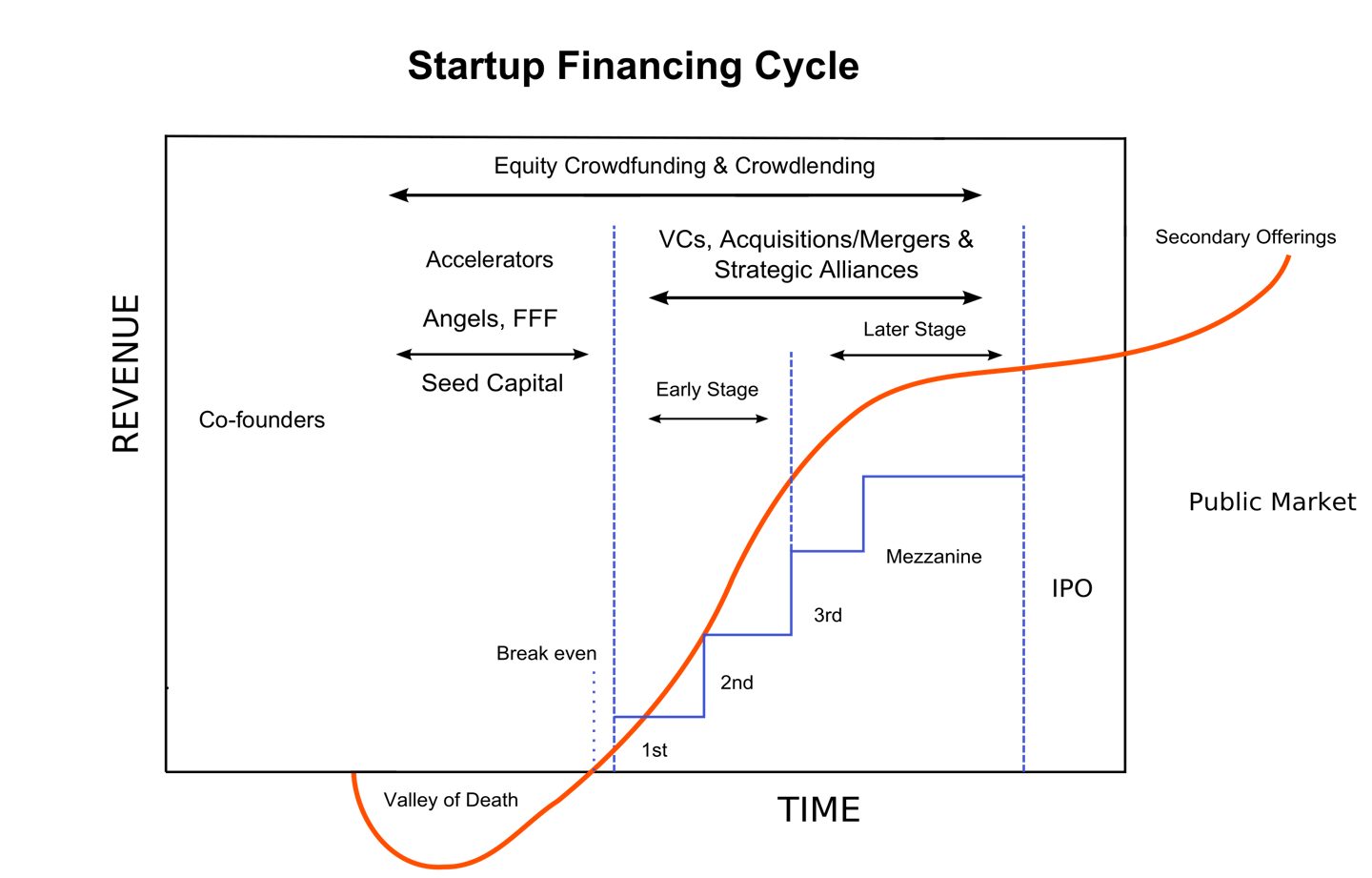
A Series E is the fifth major round of priced venture capital a startup raises, counting from its first institutional round (Series A). Reaching Series E used to be rare — most successful startups were acquired or went public long before then. For AI companies in 2026, it has become almost routine: a way to raise enormous sums while staying private, rather than a last resort before an IPO. When German defense-AI company Helsing closed a $1.8 billion Series E on July 13, 2026, valuing it at $18 billion, the round wasn’t a rescue — it was fuel for faster growth on the company’s own terms.
The funding ladder, rung by rung
Startups typically raise money in stages, each one priced by a fresh negotiation between the company and its investors and meant to fund the next phase of growth:
- Pre-seed and seed — the earliest capital, often from founders, friends and family, or angel investors, used to build a first product and find early users. Usually hundreds of thousands to a few million dollars.
- Series A — the first big institutional round, once a company can show real demand for its product. Typically $10–25 million, led by a venture capital firm that usually takes a board seat.
- Series B — funds scaling: hiring, expanding into new markets, building out the team a Series A proved was worth backing.
- Series C and D — later rounds for companies expanding internationally, acquiring smaller competitors, or building toward an eventual sale or public listing.
- Series E and beyond — once reserved for companies still private well past the point most startups either fail, get bought, or go public. Each letter marks another priced round, not a fixed amount: a Series E can be a modest top-up, or, increasingly among AI companies, a multi-billion-dollar mega-round.
Each step up the ladder usually comes with a higher valuation than the one before it, assuming the company is hitting the growth investors expect. (For more on how AI companies get built and funded, see our full startups coverage.)
Why AI startups keep raising bigger, later rounds
Three things are pushing AI companies to raise unusually large rounds unusually late:
AI is capital-intensive in a way most past startups weren’t. Training and running large models means buying GPUs, renting data-center capacity, and paying huge electricity bills — costs that scale with ambition, not just headcount. A software startup could once reach profitability on a modest Series B; a frontier AI lab often cannot.
Some of the biggest rounds aren’t pure cash. Microsoft’s investment in OpenAI, for example, is delivered substantially as Azure cloud-computing credit rather than a wire transfer — letting the nominal size of a round grow far larger than a check written from a bank account. Amazon and Google have structured parts of their Anthropic investments similarly through AWS and Google Cloud.
Investor money is concentrated at exactly this stage. According to Crunchbase, AI-focused companies captured more than 70% of global startup funding in the second quarter of 2026, up from under 50% a year earlier, and late-stage venture funding — the bracket Series E rounds sit in — hit $134 billion in that quarter alone, up 141% year-over-year. A large share of that went to a handful of companies: OpenAI and Anthropic alone accounted for 43% of all global startup funding raised in the first half of 2026.
Why it matters
A big late-stage round lets a company keep growing without the quarterly earnings calls, public disclosure rules, and short-term shareholder pressure that come with an IPO — control stays with founders and a small circle of institutional backers (pension funds, sovereign wealth funds, banks) instead of the public market. It also gives early employees and investors a way to cash out partial stakes through private sales without waiting for a public listing, which is part of why so many of these companies now carry eye-catching but hard-to-verify valuations — see our explainer on secondary market valuations for how those numbers get set.
The scale differences are stark even within one sector: Helsing’s $18 billion valuation makes it one of Europe’s most valuable defense companies, yet its US rival Anduril raised $5 billion at a $61 billion valuation just two months earlier — a reminder that American AI and defense-tech rounds are currently landing on a different order of magnitude than European ones.
In the news
Helsing’s raise is the clearest recent example: see our report on Helsing’s $1.8 billion Series E, which closed at an $18 billion valuation on July 13, 2026, with investors including JPMorgan, Lightspeed Venture Partners, Iconiq, and Canada’s public pension fund.
Sources: Crunchbase, H1 2026 venture data; Defense News on Helsing’s Series E; Wikipedia: Venture capital.