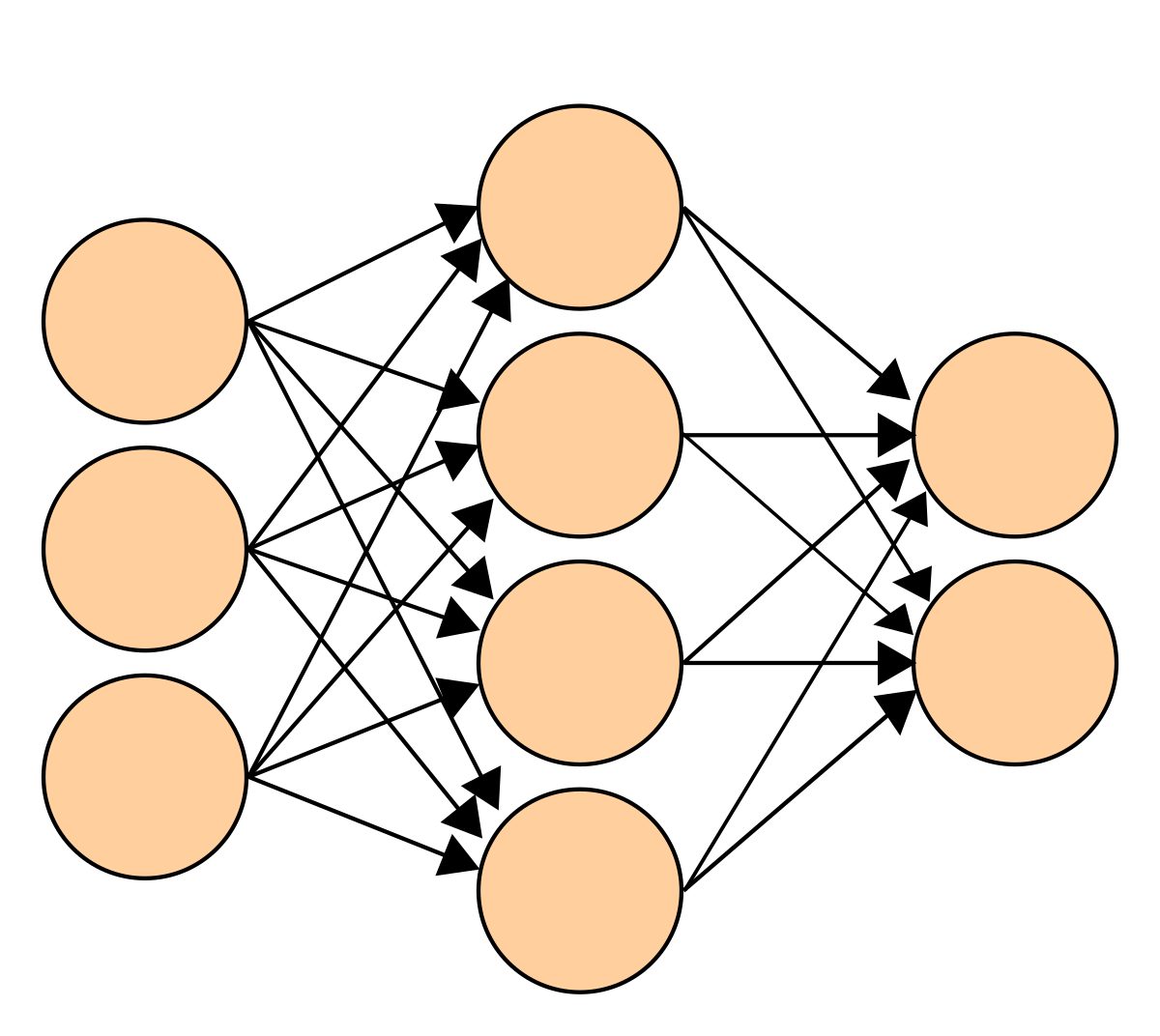
A neural network is a computing system built from layers of simple, connected units called artificial neurons, each holding a numeric “weight” that strengthens or weakens the signal passing through it. Feed the network an input — a photo, a sentence, a sound clip — and it passes that data through its layers, transforming it step by step until the final layer produces an output: a label, a word, a number. What makes a neural network powerful isn’t any single neuron; it’s that the weights across thousands or billions of them can be adjusted automatically from examples, so the network improves at a task without anyone hand-coding the rules.
How a Neural Network Is Built
Every neural network has an input layer, one or more hidden layers, and an output layer. Data enters through the input layer — say, the brightness of each pixel in an image — and each neuron in the next layer combines its inputs using its weights, then passes the result through a small mathematical function (an “activation function”) that decides how strongly to fire. Stack enough of these layers together and the network can represent increasingly abstract patterns: early layers might detect edges in an image, middle layers combine edges into shapes, and later layers recognize whole objects. A network with many such layers is often called a deep neural network, which is where the term “deep learning” comes from.
How It Learns
A freshly created neural network is close to useless — its weights start out random, so its first guesses are little better than chance. It learns through a repeated cycle: it makes a prediction, compares that prediction to the correct answer using a “loss function” that scores how wrong it was, then adjusts its weights slightly to reduce that error next time. The algorithm that works out exactly how much to adjust each weight is called backpropagation: it propagates the error backward from the output layer to the input layer, calculating each weight’s share of the blame. Repeat this cycle across millions of examples — a process explained in more detail in how AI models are trained — and the weights settle into values that let the network generalize to new data it has never seen before.
From a Single Neuron to Modern AI
The idea is old. In 1958, Frank Rosenblatt built the perceptron, a single layer of artificial neurons that could learn to separate simple patterns — the first working neural network. It couldn’t handle much, and interest in the approach nearly died out twice over the following decades. What changed things was scale: cheap graphics chips (GPUs) turned out to be very good at the matrix math neural networks need, and by the 2010s researchers could train networks with far more layers and far more data than before. That shift is what machine learning practitioners mean by “deep learning” today — and it’s the same basic layered, weighted structure, just far larger, that sits underneath the transformer architecture powering today’s chatbots and image generators.
Why It Matters
Almost every recent AI breakthrough — recognizing speech, translating languages, generating images, powering a large language model — runs on some variant of this same idea: layers of adjustable weights trained on data until they capture a useful pattern. Understanding that a neural network is fundamentally a trained statistical structure, not a mind, also explains its limits: it performs well mainly on situations similar to what it was trained on, offers no built-in guarantee of correctness, and its huge grids of numbers are hard for humans to inspect directly — which is why researchers study a separate field just to look inside them.
See It Learn
Because the idea is more intuitive to watch than to read about, Google’s free Neural Network Playground lets anyone adjust layers, neurons, and data in a browser and watch a small network learn in real time.