Companies use AI in supply chain management mainly for three things: predicting how much of a product customers will actually want, deciding where to hold inventory and when to reorder it, and catching disruptions — a late shipment, a risky supplier, a demand spike — before they turn into a stockout or a pile of unsold stock. None of this replaces the people who run supply chain management; it replaces the spreadsheets and gut calls they used to rely on.
What the AI actually does
The best-established use case is demand forecasting: machine learning models trained on past sales, seasonality, promotions, and even weather predict how much of each product will sell, often down to a single warehouse and week. McKinsey’s research on the topic found that AI-driven forecasting can cut forecast errors by 20–50% and reduce stockouts by up to 65% compared with traditional statistical methods (see Sources).
The same models then feed inventory optimization — setting reorder points and safety-stock levels automatically instead of by fixed rule, which McKinsey-cited studies put at 20–30% lower inventory for the same service level. A third use is logistics and routing: choosing carriers, consolidating shipments, and rerouting around a blocked port or a delayed truck. A fourth is supplier risk monitoring, where models scan news, shipping data, and financial signals to flag a supplier likely to miss a delivery. The newest layer, often called agentic AI, lets software act on these signals directly — reordering stock or rebooking a shipment — and escalate to a person only when something falls outside normal bounds.
How a company actually starts
Adoption rarely begins with a company-wide rollout. A practical step-by-step guide to introducing AI forecasting lays out the pattern most successful projects follow: start with a narrow proof of concept — one product category or one warehouse — and check whether the model actually beats the existing forecast. If it does, connect it to a live planning process where a real planner acts on its output, not a dashboard nobody looks at. Only after that pilot proves itself does the tool expand category by category, with monitoring in place to catch when the model’s accuracy drifts.
Tips and pitfalls
These projects fail most often not because the model is wrong but because nobody changes a decision based on it — a forecast that never reaches the person who sets reorder quantities is decoration, not an improvement. Data quality is the other common failure point: a model trained on messy, inconsistent sales history will confidently produce a bad forecast. And because most of these tools sit on top of existing ERP, warehouse-management, and transportation-management software rather than replacing it, integration work is usually the slowest part of a project, not the AI itself.
Why it matters for Georgia
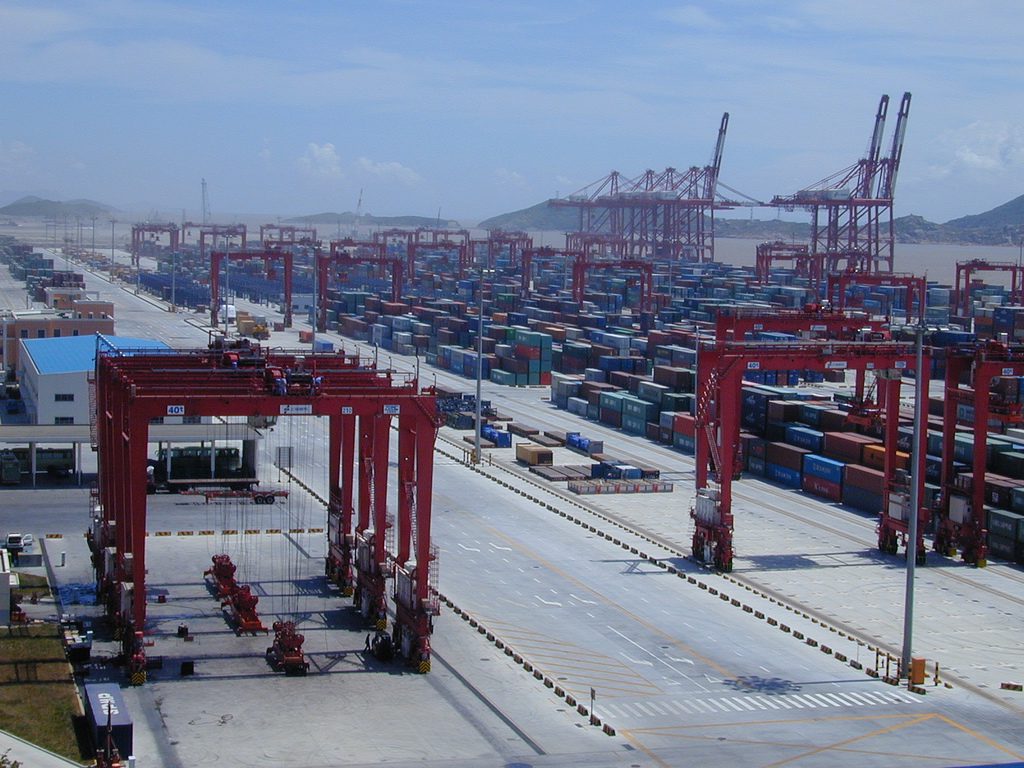
Georgia’s ports have handled sharply more cargo lately — throughput was up 21% in the first four months of 2026 compared with the same period a year earlier — as the country builds out its role in the Middle Corridor, the trade route linking China and Central Asia to Europe through the South Caucasus, including the new Anaklia deep-sea port. That growth is exactly the kind of pressure that pushes freight-forwarders and logistics operators toward the forecasting and routing tools described above, to keep shipments moving without over- or under-committing warehouse and trucking capacity.
In the news
The category is drawing serious investment: Seattle-area startup Auger, founded by a former Amazon global-consumer-business CEO, raised $50 million to build software that pulls data from a company’s existing ERP, warehouse, and transportation systems and lets AI agents make routine supply-chain decisions automatically.
Sources: McKinsey & Company research on AI in supply chain forecasting and operations; Auger, Inc. Series B funding coverage (GeekWire, PYMNTS); Georgian port-cargo throughput reporting, 2026.