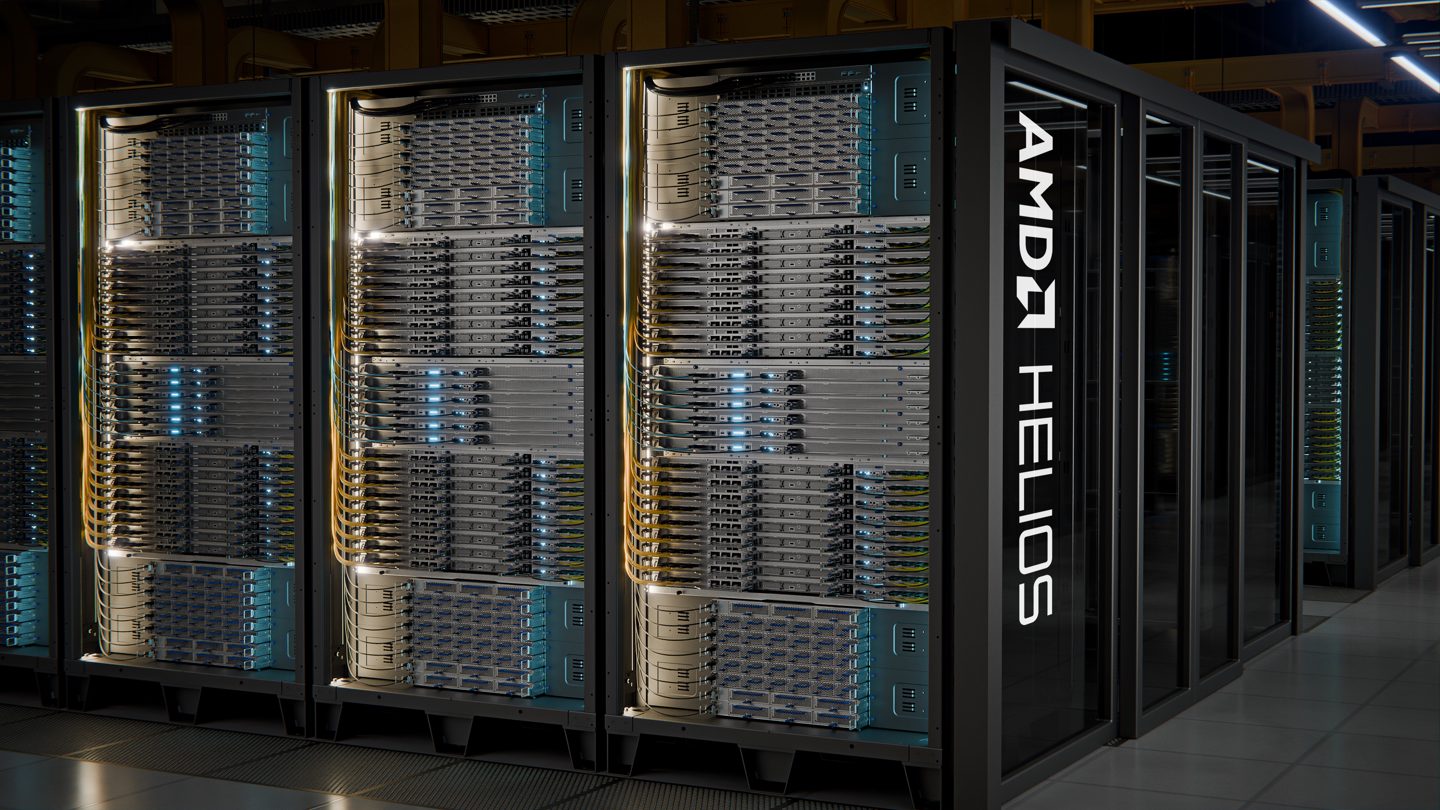
AMD unveiled its next-generation Instinct MI400 series of AI accelerators on July 23 at its Advancing AI 2026 conference in San Francisco, entering the AI chip market with hardware the company says outperforms its own previous generation by a wide margin.
The new chips
The lineup centers on two GPUs: the MI455X, aimed at large-scale AI training and inference, and the MI430X, built for sovereign AI and scientific computing with up to 288 teraflops of FP64 performance. Both use HBM4 memory. AMD said the MI455X delivers 34 times the token throughput of its MI355X predecessor — a measure of how much text a chip can generate per second, and a major cost driver for running large language models at scale.
Helios and the Nvidia question
AMD paired the chips with Helios, a rack-scale system that packs 72 MI455X GPUs and 18 of the company’s new sixth-generation EPYC “Venice” server processors into a single unit. AMD said a fully loaded Helios rack delivers up to 30% more inference tokens per dollar than competing systems — without naming Nvidia directly, though Nvidia’s chips currently dominate the data center AI market AMD is targeting. AMD also introduced Ryzen AI Embedded X100 processors and a Kria AI robotics developer platform, alongside updates to ROCm, its open-source alternative to Nvidia’s CUDA software.
“The next phase of AI will span frontier models, agents and physical AI, creating new opportunities to bring intelligence everywhere,” AMD CEO Lisa Su said at the event.
Partners, but no orders yet
The launch doubled as a showcase of AMD’s ecosystem ties. OpenAI executives Sachin Katti and Philippe Tillet joined the keynote to discuss deeper collaboration across AMD’s hardware and software stack, Meta published details on how it plans to scale infrastructure using EPYC and Helios, and Anthropic co-founder Tom Brown appeared alongside AMD’s leadership. None of the three companies announced binding chip-purchase commitments at the event, and AMD did not disclose pricing or shipping dates for the MI400 series.
The launch follows a similar unveiling weeks earlier from Qualcomm, underscoring how crowded the race to challenge Nvidia’s grip on AI infrastructure has become.